

Quantum computing and its supremacy over the classical computer capture the imagination of people all over the world. Less known, but no less fascinating is the practical application of quantum phenomena to build sensors that can measure what is otherwise impossible. Scanning a single cell, looking around a corner, hearing a mouse eat in a grain silo, all of this becomes possible thanks to quantum sensors.

Investment Analyst at Verve Ventures
About the author: Emma Schepers is Investment Analyst at Verve Ventures. She has a master’s degree in quantum physics and quantum decision-making from ETH Zurich.
Background: the second quantum revolution
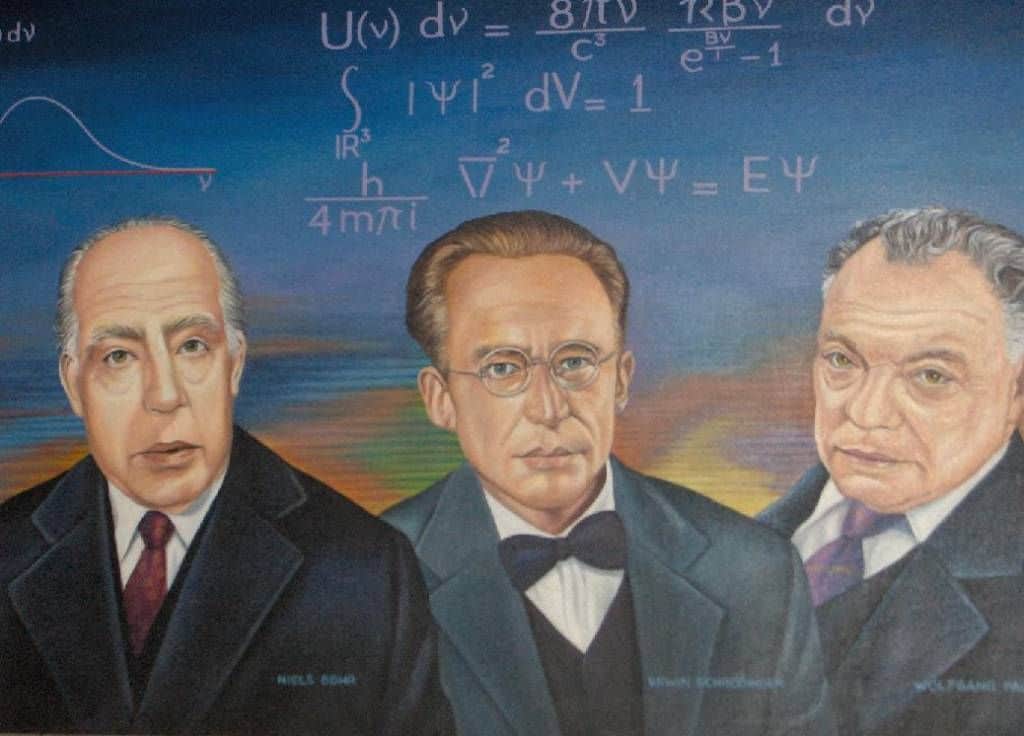
In the early 1900s, the emerging field of quantum physics completely changed our understanding of nature at the smallest scale. For the first time, scientists started to understand what fundamental processes shape the way in which nature behaves. Great minds such as Wolfgang Pauli, Albert Einstein, and Erwin Schrödinger (the owner of Schrödinger’s cat) were at the core of the first quantum revolution. Whereas this revolution mainly gave us more understanding of natural phenomena, the second quantum revolution that started in the late 1990s now starts to translate this knowledge into technology. Because if we understand what happens at the nanoscale, why not use these properties for good?
Nowadays, everybody has heard of these mysterious quantum computers that are supposed to change our life with their unlimited computing power. However, there is another, much less known field within quantum technology that is about to affect our daily life. In fact, the first applications are already a reality.
The simple definition of a quantum sensor is any technique that uses quantum phenomena as the basis for measurements. Because of the very small scale at which these phenomena occur, quantum sensors can measure properties with unprecedented sensitivity and thus allow detection of what currently goes unobserved. As an example, with a quantum sensor, it could become possible to detect very small deviations in gravity as an indication of an upcoming earthquake or precisely measure the brain activity in real-time, detecting anomalies.
The different types of quantum sensors
The quantum sensing field comprises multiple technologies that use different quantum particles and systems to make measurements. At a high level, these technologies can be divided into three categories. On the one hand, we have optical sensors, based on the properties of light (‘photonic systems’), and on the other hand, there are the so-called solid-state systems that use the physical properties of electrons or atoms. Also exploring the properties of atoms, especially alkali metals, is the third category of atomic vapor sensors.
Photonic systems
Optical metrology (measurement) systems have been around for quite some time. At the core, an optical sensor uses the properties of light to make measurements. One can for example direct a light beam onto a sample and detect the reflected light to discover material properties. With quantum-optical metrology, it is possible to significantly increase the sensitivity of the measurements by allowing the detection of the single photons that a light beam is composed of. Even these single-photon detectors have a natural limit when it comes to sensitivity. However, by exploiting the unique quantum phenomenon of entanglement this limit can be surpassed to reach unprecedented sensitivity.
Quantum entanglement was first introduced by Einstein and is sometimes referred to as “spooky action over distance.” It is, for example, at the base of quantum teleportation protocols that have become famous as a demonstration of quantum supremacy. Two entangled photons together form one quantum state, meaning that the physical properties of the two photons are perfectly correlated. As a result, measurements performed on one photon, directly reveal the state of the other photon as well. Imagine generating a photon pair such that their total magnetic spin is zero. If, at one point, one of the photons is found to have spin up, this implies that the other photon has spin down to reach a total spin of zero.
This entanglement has many applications for quantum cryptography and quantum computing, but also plays a major role in quantum sensing and imaging. One could for example use two entangled light beams that both have a different wavelength. Different wavelengths, allow measuring different things. For example, extremely small vibrations are only visible with extremely short wavelengths, but these light sources are difficult to detect. With entangled light beams you could tailor the wavelength of one of the beams to the property you want to measure while optimizing the wavelength of the other beam to the detection equipment that you are using. Like this, extremely precise images of the very small become a reality.
Solid-state systems
As introduced above, solid-state quantum sensors are based on the properties of electrons or atoms. Specifically, they use the reaction of these particles on external stimuli to measure the environment with very high accuracy. The startup Qnami is commercializing a concept called scanning NV microscopy which uses a single nitrogen atom to measure magnetic fields.
A perfect diamond is made up of a completely uniform arrangement of carbon atoms. Such a stone shines in pure white. When a diamond is colored, this actually means that the atomic lattice is imperfect because some carbon atoms got displaced by other types of atoms. The color of blue diamonds, for example, is most often caused by boron atoms substituting for carbon atoms in the crystal lattice.
The most common impurity in diamond is nitrogen, a gas that is abundant in the atmosphere. When there is a nitrogen atom in the diamond lattice next to one missing carbon atom, the result is a so-called “nitrogen-vacancy color center”, or “NV center” for short. This defect does not only emit light, but it also has an intrinsic quantum property that Qnami exploits: It can be used as a nanoscopic “compass needle”. It can sense the strength of very small magnetic fields.
When the NV center comes close to a magnetic surface, the particles in the sample and the sensor interact. This results in a change in the energies of the NV center spin states. As a comparison, once a magnet is held close to a compass, the needle will no longer point north but will follow the magnet as it moves around the compass. The same happens here at the nanoscale. The spin of the NV center changes its orientation according to the magnetic field of the sample. The change in spin orientation can be detected very precisely by exciting the NV center with a laser. When the spin falls back into the original orientation, the additional energy is released in the form of light. By measuring the frequency of the emitted light, the strength of the magnetic field can be determined. The higher the frequency, the higher the energy and thus the stronger the magnetic field (see image below).
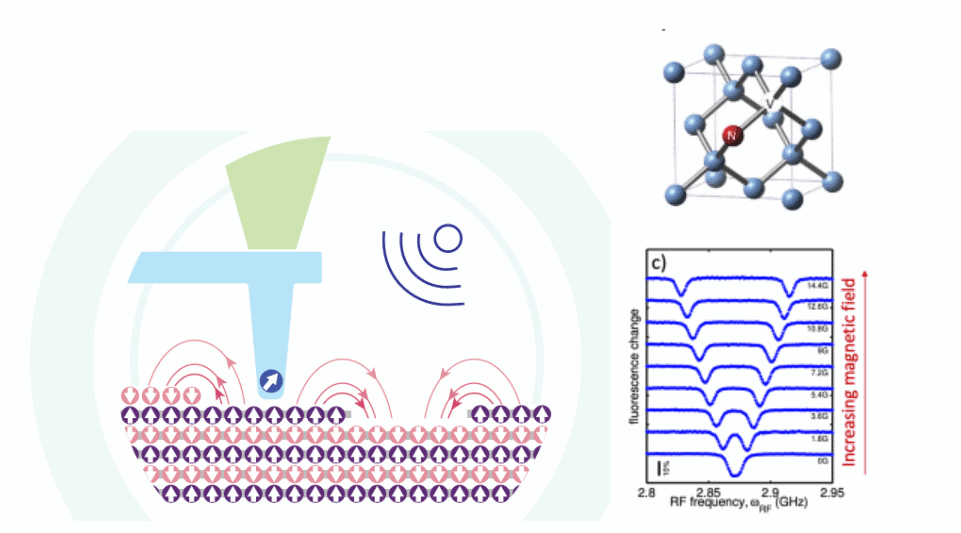
In this schematic of the Qnami diamond probes, the single electron in the NV center (see top right) reacts to the magnetic surface (left) leading to a dip in the fluorescence intensity as is shown in the graph on the right.
Theoretically, this technique allows ultra-precise measurements of the magnetic field. In practice, however, the sensitivity highly depends on the quality of the diamond probe, in particular, how close the NV center is to the surface. Qnami’s core competence lies in the manufacturing of these diamond needles. To give an indication of how difficult that is, it takes Qnami 40 steps and 2 to 4 weeks to produce 1000 ‘Quantilevers’ from a 1 cm2 piece of synthetic diamond.
Atomic vapor sensors
This third upcoming class of quantum sensors does not use a single particle, but a whole cloud of alkali atoms such as rubidium trapped in a small gas chamber. Each of these atoms has its own magnetic spin, initially pointing in a random direction. With a laser beam one can force all these spins to point in the same direction such that a light beam can shine right through. If the atom cloud comes close to an external magnetic field, the atoms react by changing the orientation of the magnetic spin. The same laser beam can now be used as a probe. Because the spins are no longer aligned, only a smaller amount of the light beam reaches the other side of the cloud. The stronger the magnetic field, the less light is transmitted, providing a way to measure very small changes in the magnetic field.
How are quantum sensors changing the world?
Magnetic fields are just one example of what a quantum sensor can measure. Using different properties of photons, electrons, and atoms quantum sensors can also be used to measure temperature, electrical signals, vibrations, or gravitational changes, among others. But why do we want to measure these quantities with such great precision?
For scientists, having a way to quantitatively measure the smallest magnetic fields helps in the development of new materials and understanding their behavior at the subatomic level. This becomes increasingly important now that computer chips for example have become so small that quantum properties start to play a role. In the quantum regime, the materials behave completely differently, therefore these interactions have to be taken into account when building chips at a super small scale. Else, our computers and mobile phones simply won’t improve anymore.
Another area where detecting magnetic fields has a lot of value is in biological imaging. Current MRI scanners are already based on the detection of magnetic fields, however, with quantum sensors, one could pick up much smaller deviations in for example the brain activity. Using atomic vapor sensors researchers have already developed the first versions of a super MRI that can measure brain activity. In the future, it could even become possible to take MRI pictures of single cells.
Bioimaging is also an important use case for optical technologies. Because two entangled light beams with different wavelengths can be used, it is possible to visualize biological objects that are only detectable with very small wavelengths. This allows us for example to ‘see’ protein distributions within cells that are not accessible with visible light.
There are also many industrial applications for photonic sensors. A good example is the photonics sensors developed by the startup Miraex. Because the sensors are fully based on photons and thus light, no electronics are needed in the actual sensors. Therefore, the sensors can operate in extremely harsh conditions while providing unprecedented accuracy in the measurement of pressure, vibration, temperature, and more. There is a wealth of possible applications, and some of them are mind-boggling. Picture a grain silo in the country-side. It is filled with grain, which forms deposited layers of dust. During the operations of loading and unloading, such layers, because of the motion due to the circulation of air, generate a permanent cloud inside of the silo. These clouds form an explosive atmosphere that could be triggered by the slightest spark an electronic device could produce. A photonic sensor, on the other hand, is perfectly safe and can be used to detect hungry rodents. Miraex’s sensors are so sensitive that they can hear a mouse chewing on grain in a silo that might hold 500 tons.
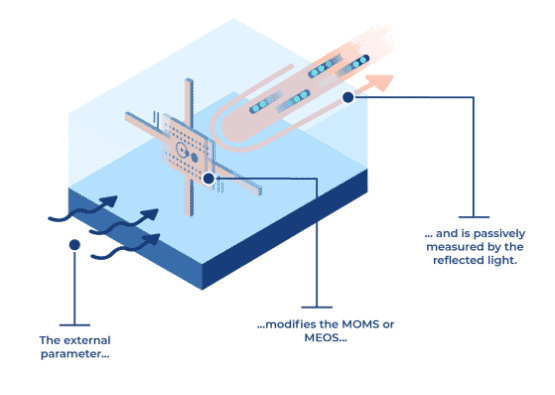
The Miraex photonic sensor solution
Beyond the photonic sensors for physical properties, Miraex is also developing so-called ‘Quantum converters’ that transform microwaves into photons. Microwaves are the basis of most radar- and satellite communication systems and the integration of the electronics-free quantum converters would drastically reduce the noise levels and therefore increase the sensitivity and bandwidth of such applications. In addition, the photon signals can be fed into an optical fiber to connect several quantum devices such as quantum computers to form a network.
Building on the same technology, Miraex is also developing so-called Quantum converters for the detection of microwaves, the signals frequently used in radars and satellite communication. These electronics-free quantum sensors will drastically reduce the noise levels and will therefore dramatically increase the sensitivity and bandwidth of such applications. In addition, because the microwave systems are converted to photons instead of electrical signals, they can be fed into an optical fiber and connect several quantum devices together to create a network of for example quantum computers.
Another example of how optical sensors can be used in practice is so-called 3D lidar technology. Classical lidar technology relies on measuring the reflection of light pulses by a surface, basically a radar technology but with light waves. Quantum sensors do not only allow to detect the reflection of the light beam as a whole but the detection of the single photons within the beam. Researchers at the University of Glasgow have built a spatial orientation system for self-driving vehicles based on this principle. Their prototype can already detect moving persons that are 100m away, even if they are a few meters around the corner and thus invisible for other systems.
Although most quantum sensing systems are not fully mature yet, they are rapidly approaching not only the academic but also the industrial market. Quantum sensing systems are already used in niche applications for gravitational changes beneath the earth’s surface as a proxy for volcanic activity for example.
We held a roundtable discussion with startup founders of Miraex, C12 Quantum Electronics, and Orca Computing. You can watch the session here.
Quantum computers
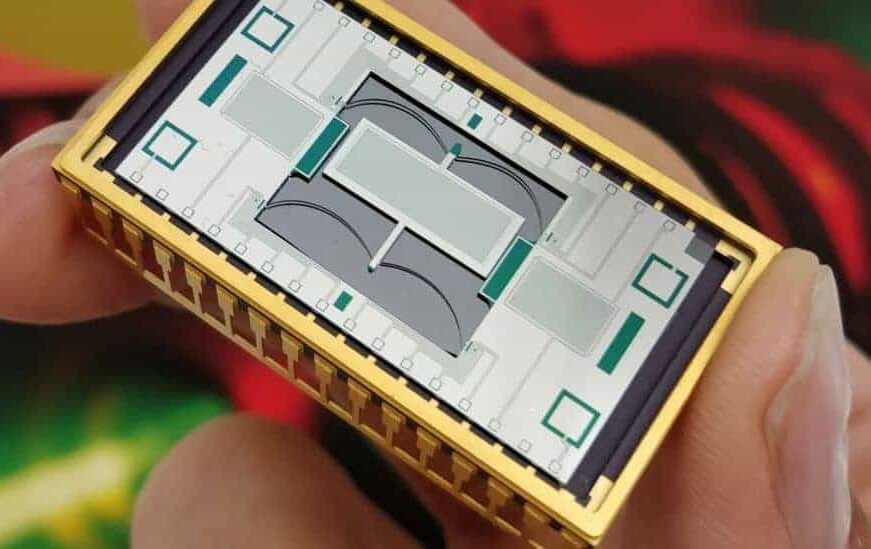
Back to the quantum computers, because how are they going to benefit from quantum sensors? Besides general advances in quantum technology, quantum sensors also play a major role in the development and quality control of quantum computers. Imagine researchers developing a qubit, the quantum version of a classical computer bit. Nowadays, to test the design they have to implement the qubit into the computing system and turn it on to see whether it is working or not. If not, they go back to the drawing board and tweak some parameters, which is a bit like fumbling in the dark.
With the introduction of quantum sensors, however, researchers will be able to perform quantitative measurements on the qubits before and after they are implemented into a quantum computer. This that they will not only discover whether there is a defect in their system but also what the nature of this defect is. As a result, quantum sensors promise to speed up the R&D process decisively.
(There are plenty of other startups whose work will accelerate the development of quantum computing and sensing, such as Kiutra. Its cooling system can magnetically achieve temperatures close to absolute zero (near -273 °C) on a permanent basis).

Summary
Europe is investing heavily in quantum technology. The Quantum Flagship was launched in 2018 as one of the largest and most ambitious research initiatives of the European Union. With a budget of at least EUR 1 billion and a duration of 10 years, the program brings together research institutions, academia, and industry partners. France has announced a EUR 1.8 billion strategy to turn itself into becoming a quantum powerhouse. Germany has earmarked EUR 2 billion for quantum research and recently chosen “Quantum sensors of the future” as one industry cluster worthy of additional support (Qnami is part of this cluster).
The second quantum revolution gives rise to new ecosystems which include specialized investors such as Quantonation, a fund we have co-invested with in the past. Quantum sensing might be the most prominent example of innovation, but we see quantum sensing as an interesting enabling technology that will have a widespread impact on society and we aren’t shy to invest early in startups in this field. We encourage you to watch this roundtable discussion with Startup Founders of Qnami and Kiutra and Venture Capital Firms Quantonation and Verve Ventures.
Written by
Investors
Our sophisticated investors include visionary family offices, leading wealth managers, institutions, founders, and senior executives. These individuals and organizations are all committed to shaping the next generation of innovation.
More News
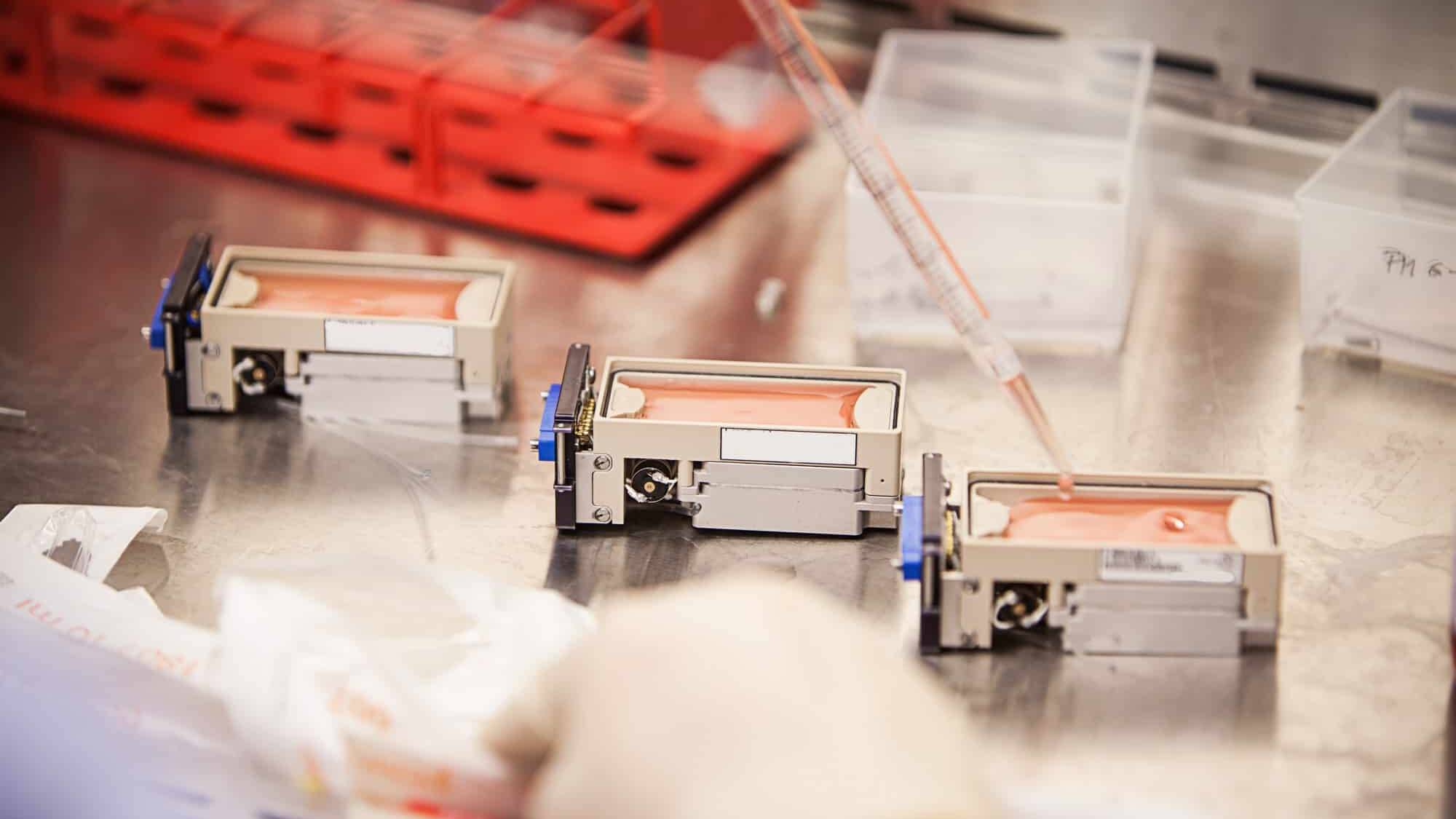
Why space biology is a new gold rush
Daniela Bezdan is an expert in space biology and well-connected to space agencies NASA and ESA. She has monitored astronauts’ health and trained them. In our interview, she explains how startup yuri helps making research in space more accessible.
Qnami (Quantum Sensors): CHF 2.6 Seed round
Qnami has raised CHF 2.6 million from Quantonation, investiere, ZKB Starup Finance and High-Tech Gründerfonds. investiere contributed CHF 1 million to this round.

Quantum sensors: The Revolution You’ve Never Heard Of
Patrick Maletinsky is recognized worldwide as an expert in the field of quantum sensors. He explains why he sees significant economic and scientific potential in quantum sensing already in the near-term.